

You just invested in a shiny new device, appliance, or a piece of furniture you've been eyeing for months. Now it's time for one more purchase: a product protection plan.
Product protection plans offer coverage beyond the manufacturer's warranty, shielding you from unexpected repair or replacement costs. In this guide, we’ll share how they work, why you should purchase one, and why businesses offer them to customers.
What Is a Product Protection Plan?
A product protection plan, sometimes called an extended warranty or service contract, offers more coverage than a standard warranty. It protects your purchase against issues that the original warranty either doesn't cover or stops covering once it expires.
While manufacturer warranties typically last only one to two years and cover defects in materials or quality, product protection plans extend those core features and often add coverages for things like:
- Mechanical or electrical failures that occur after the original warranty expires
- Accidental damage such as drops, spills, stains, or cracked screens (depending on the plan)
- Power surges and other unpredictable events
- Labor and parts costs associated with repairs
- Unlimited repairs through more premium plans
You'll usually purchase a product protection plan from:
- Retailers like Best Buy, Amazon, or Walmart
- Manufacturers like Apple through AppleCare
- Third-party providers that specialize in protection plans
In most cases, dealers offer product protection plans at the point of sale (when you buy the product). However, many providers also allow you to purchase a plan within a set window after the original purchase (often 30–60 days, but sometimes up to a year).
Additionally, some major credit cards provide a limited layer of protection by extending the manufacturer's warranty up to an extra year. It's always worth checking with your card issuer to understand what's included.
The Product Protection Ecosystem
Understanding who's involved in a protection plan helps clarify how coverage actually works:
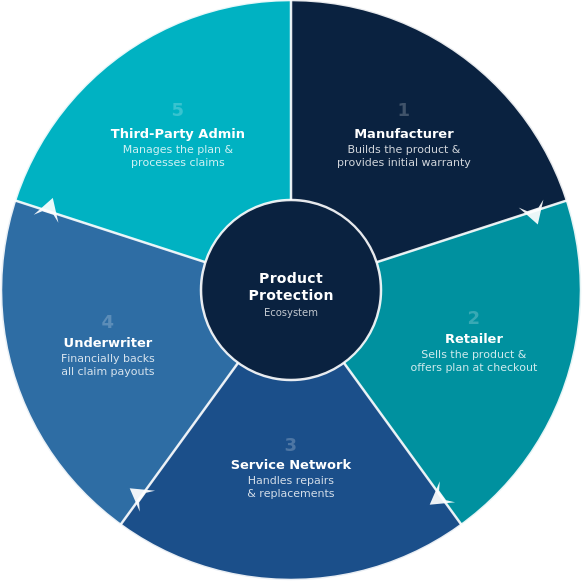
- The manufacturer builds the product and provides the initial warranty.
- The retailer sells the product and may offer manufacturer, in-house, or third-party product protection plans.
- A third-party administrator manages the protection plan and handles claims processing.
- An underwriter helps determine plan pricing and provides financial backing to pay out claims.
- A service or repair network repairs or replaces items when plan administrators approve a claim.
How Protection Plan Claims Are Handled
Filing a claim is generally a straightforward process with most protection plans:
|
Step |
Action |
What Happens |
|
1 |
File a Claim |
Contact the plan provider online, by phone, or via their app with your purchase receipt and plan info ready. |
|
2 |
Assessment |
A claims adjuster reviews the issue to verify it falls within the plan's coverage terms. |
|
3 |
Service & Resolution |
If approved, the product is repaired, replaced, or you may receive reimbursement up to the plan's limit of liability. |
Your claims adjuster will check if the claim is valid and confirm it meets the terms of the protection plan before approving a resolution.
Limits of Liability
Every protection plan’s limit of liability determines the maximum dollar amount the provider will pay over the life of the plan. Your limits of liability will usually equal to the original purchase price of the product.
For example, if you purchased a $3,000 laptop:
- The plan pays $1,000 for Repair #1 and $500 for Repair #2.
- You have $1,500 remaining in coverage.
Whether you have an eroding or non-eroding plan can also affect your limit of liability:
- Eroding plans reduce the limit of liability with each claim payout, meaning your total coverage decreases over time, like in the example above.
- Non-eroding plans keep the full liability limit for each approved claim, regardless of how many claims the plan pays.
Product Protection Plans vs. Insurance & Warranties
People often use the terms “manufacturer warranty,” “product protection plan,” and “insurance” interchangeably. However, they serve different purposes and have distinct terms.
Here's a clear breakdown:
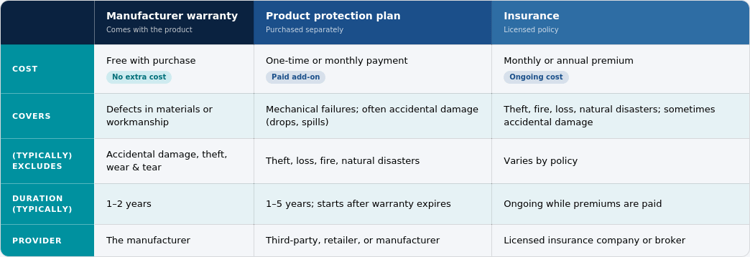
The manufacturer's warranty assumes your product will work as intended for a limited time. It's included at no extra cost but offers the narrowest coverage.
A product protection plan usually starts where the warranty ends and covers drops and spills, depending on the plan. If your protection plan covers accidental damage or has other extra benefits, they may overlap with the product's manufacturer's warranty.
Insurance covers scenarios beyond your control like theft, fire, loss, and natural disasters. The law categorizes insurance products differently, and a licensed seller may need to sell them.
Some insurance products also overlap with protection plan coverage for accidental damage and mechanical breakdowns.
What matters most is what's covered and who's financially backing the coverage.
Why Should I Get a Product Protection Plan?
Consumer demand for comprehensive product coverage is growing. Here's why a protection plan may be worth it for you:
- Avoid surprise out-of-pocket costs: Repairs for electronics, appliances, and furniture can cost hundreds or thousands of dollars.
- Extended coverage beyond the warranty: Once the manufacturer's warranty expires, you're on your own—unless you have a plan.
- Accidental damage protection: Many plans cover drops, spills, and mishaps that a standard warranty never would. You won’t need to worry about determining what counts as accidental damage vs. normal wear.
- Streamlined repairs: Plan providers coordinate repairs through their service network, saving you the hassle of finding a technician yourself.
- Customer service support: Many plans include tech support and dedicated customer service to help troubleshoot issues.
Of course, no plan is perfect. You may encounter:
- Additional upfront cost: Plans require an investment, either as a lump sum at purchase or through monthly payments.
- Coverage gaps: Every plan does not cover all types of damage. Always read the fine print.
- Claim denials: An administrator or underwriter can deny a claim if they determine it falls outside the plan's stated terms.
Ultimately, the decision comes down to the value of the product, your tolerance for financial risk, and the level of coverage offered.
How Are Product Protection Plans Priced?
Dealers typically offer plans as a one-time payment at checkout, a monthly subscription, or bundled into a product financing package. The cost of your product protection plan depends on several factors:
- Product category: Electronics, appliances, fitness equipment, and furniture each carry different risk profiles, which affects pricing.
- Coverage type: Plans that include accidental damage coverage typically cost more than those that only cover mechanical and electrical breakdowns.
- Plan duration: Longer coverage windows (e.g., 3–5 years) cost more than shorter ones.
- Provider: Pricing varies across retailers, manufacturers, and third-party administrators.
- Eroding vs. non-eroding structure: Insurers tend to price non-eroding plans higher because they offer greater long-term value.
When evaluating cost, compare it against the potential repair or replacement cost of your product. If repairs are likely to exceed the plan premium, your protection plan pays for itself.
Why Businesses Should Offer Product Protection Plans
For businesses—whether retailers, manufacturers, or service providers—offering product protection plans is becoming an industry standard.
Here's why businesses should consider adding protection plans to their product and service offerings:
- Increased revenue: Protection plans represent a high-margin revenue stream that grows with each product sold.
- Customer loyalty: Consumers who purchase a protection plan are more invested in their relationship with your brand. When a claim is handled smoothly, that trust deepens.
- Market differentiation; In competitive categories like technology, fitness equipment, appliances, and furniture, offering robust protection sets you apart.
- Improved customer service experience: Plans with tech support and simpler claims make ownership easier and smoother.
- Brand association with reliability: Customers associate your brand with quality and confidence when you stand behind your products.
Businesses can use third-party administrators like Safeware to launch and manage protection plans without building infrastructure from scratch. Third-party administrators handle everything from underwriting to claims processing to customer service.
Making the Right Choice with Protection Plans
Whether you're a consumer looking to protect a major investment or a business exploring ways to add value for your customers, understanding your product protection plan options puts you in a better position to make the right choice.
Ready to add protection plans to your products and services? Contact Safeware to learn how to offer your customers the protection they need.
Frequently Asked Questions
Can I buy a protection plan after purchase?
Yes. Many providers allow you to purchase a plan within a defined window after the original purchase—often within 30 to 60 days. Some providers may require a product inspection before approving a plan for items purchased outside the immediate checkout window.
Do refurbished products qualify for a protection plan?
It depends on the provider. Some plans do cover refurbished or certified pre-owned items, but eligibility requirements vary. Confirm with your plan provider before assuming coverage applies.
What happens if I sell the product?
Some protection plans are transferable, meaning the remaining coverage can be passed on to the new owner. This can actually increase the resale value of your product. Check with your plan provider for the specific transfer process.
How do I file a claim?
Most providers allow you to file a claim through their website, mobile app, or customer service line. You'll typically need your original purchase receipt and protection plan details on hand when you contact them.
What if my claim is denied?
If a claim is denied, you have the right to request clarification in writing and, in many cases, formally appeal the decision. Many reputable providers have structured appeal processes. Review your plan's terms carefully to understand what's covered and what's excluded before filing.
What if I need to file a claim for accidental damage?
Accidental damage coverage—covering drops, spills, cracked screens, and similar mishaps—is available on many plans but is not universal. Confirm whether your plan includes accidental damage protection at the time of purchase.
How do I sell protection plans as a business?
The process depends on your chosen partner. Third-party administrators like Safeware offer streamlined onboarding processes that handle the heavy lifting—including plan design, underwriting, claims management, and customer service support. Contact Safeware today to learn how to add protection plans to your product and service offerings.


.png)